AI Strategy Finder
Straddles and strangles with AI
Non-directional option strategies — a call and a put sold (or bought) together, at a fixed time or when the index gives a signal — found and tested by our AI on real option prices.
What a non-directional strategy is?
#A directional strategy bets on the index going up or down. A non-directional one sells (or buys) a call and a put together, so it does not need to know the direction. A straddle uses the ATM call and put; a strangle uses a call above and a put below the ATM.
Selling earns when the market stays calm and the options lose value through the day (time decay, or volatility cooling off). Buying earns when the market makes a big move either way.
Choose it on Find strategies → Trading → Strategy style (in the Market box) → Non-directional (straddles & strangles).
What you choose?
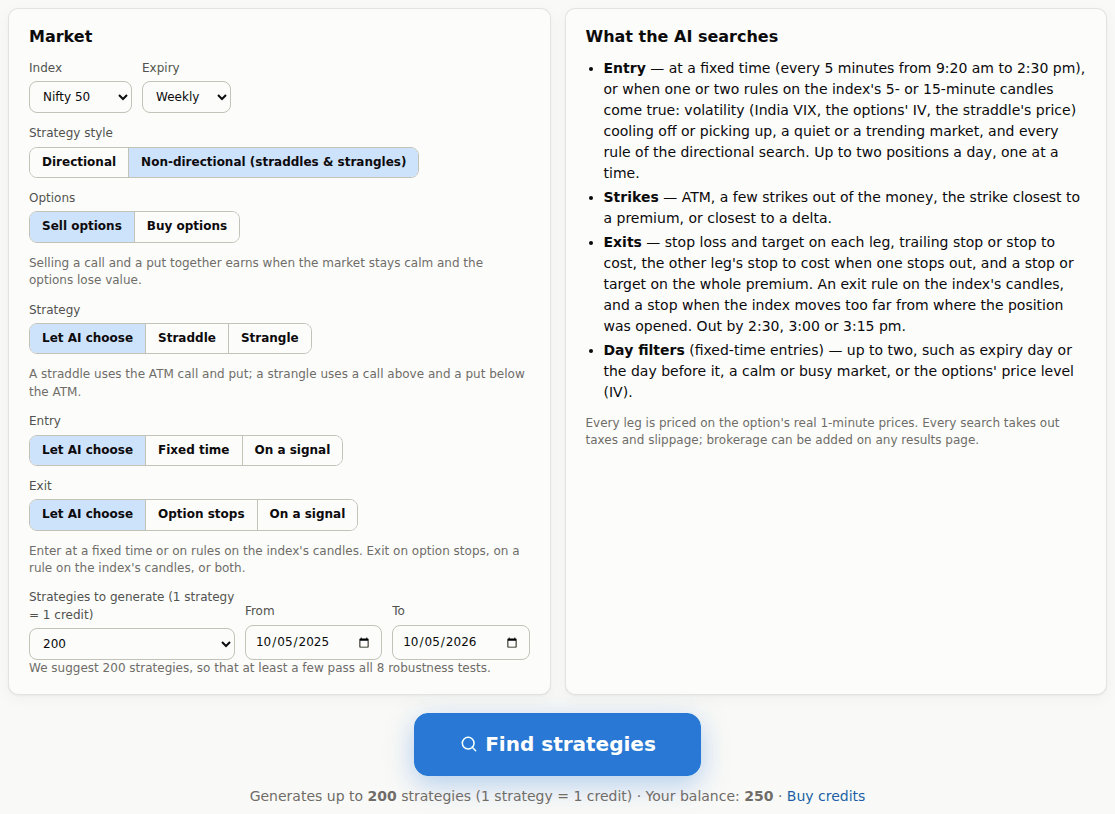
#- Index and Expiry — Nifty 50 weekly or monthly, Nifty Bank monthly, Sensex weekly.
- Options — Sell options (the default) or Buy options.
- Strategy — Let AI choose, Straddle or Strangle.
- Entry — Let AI choose, Fixed time, or On a signal (when rules on the index's candles come true).
- Exit — Let AI choose, Option stops (stop loss and target on the options), or On a signal (a rule on the index's candles closes the position).
- Strategies to generate and the dates — the same as a directional search; 1 strategy = 1 credit.
What our AI searches?
#Our AI tries thousands of combinations and keeps the best:
- Entry at a fixed time — a round 5-minute time during the day (never 9:36 or 10:23). One position a day.
- Entry on a signal — rules on the index's candles, for example about volatility cooling off (good for selling) or picking up (good for buying). The position opens at the next candle's open, at most one at a time and up to two a day (the second one at the strikes of that moment).
- Strikes — ATM, out of the money, the strike whose price is closest to an amount, or the strike closest to a delta.
- Exits — stops, targets, trailing stops and stops moved to cost on each leg or on the whole premium, an exit rule on the index's candles (out at the next candle's open), and an index move stop that closes both legs if the index moves too far from the entry. Whatever is open closes at the chosen time in the afternoon.
- Day filters (fixed-time entries) — for example expiry day, a calm or busy market, or the options' price level (IV).
The 8 tests
#Each strategy goes through 8 tests, like a directional one. Three are different: Beats random strategies (the same exits with random entries and random strikes must do clearly worse), Survives a late entry (a delayed entry still works) and Survives double slippage (with every leg's slippage doubled it still makes money — this replaces the noisy-prices test, because each leg is priced on the option's real prices).
The strategies that pass all 8 — and meet the return requirement after taxes and slippage — are shown first, in green. No two of them are near-copies: a strategy that behaves almost exactly like a better one is left out.
Results and the strategy page
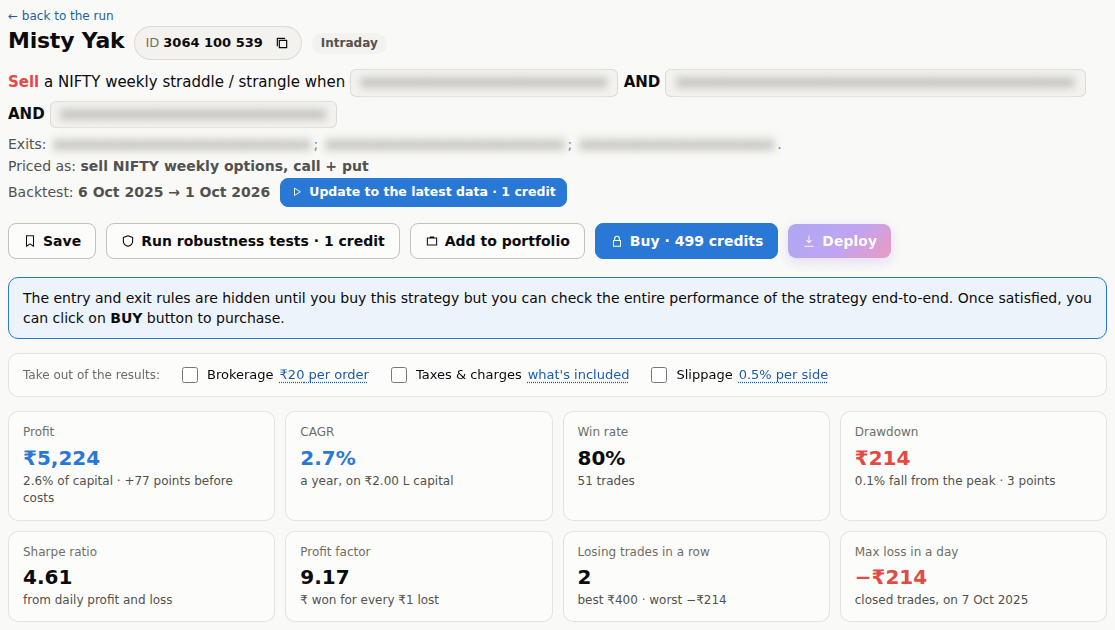
#The results list and the strategy page look the same as for directional strategies. A trade is one day's position: the call and the put together, with the reason each leg closed (for example CE stop loss · PE exit time).
Starting capital: ₹2,00,000 for selling, ₹50,000 for buying. Every leg pays taxes and slippage (at least one ₹0.05 price step a side).
Before you buy a strategy, its entry time or entry rules, strikes, filters and exits stay hidden, and its trades show only the day.
Good to know
#- Our option prices cover 10 strikes on each side of the ATM. On a wild day there may be no strike at the asked price; that day is skipped.
- Buying strategies usually make their money on a few big days and lose a little on most others.
- Straddles and strangles go into portfolios like any strategy (each day's position counts as one trade), and Edit & re-test changes the entry (a fixed time or rules), exit time, strikes, exits, exit rule, index move stop and filters (1 credit a re-test).
- Deploy sends a bought fixed-time straddle or strangle to TradeBots: the bot enters at the same time, exits each leg the moment its live price crosses the stop or target (the backtest fills those levels where the minute's high or low touched them), applies the same day filters and exits at the same time, as backtested. Its code downloads as a TradeBots file or JSON. Straddles that enter or exit on a signal deploy to TradeBuilder: both legs go in together or not at all, one position at a time, with the same entry and exit rules on the index's candles and every exit — including the index move stop — on the live prices.