Discretionary Trading Tools
Trade Scalper: Getting Started
The discretionary tool for intraday traders and scalpers, with advanced controls built for option traders.
A discretionary tool for intraday traders and scalpers
#Trade Scalper is discretionary. Nothing is automated: you decide every entry and every exit yourself, and the screen exists so that decision can be acted on in one click.
It is built for intraday traders and scalpers — people going in and out through the session, for whom fumbling with a form is the difference between a good fill and a bad one.
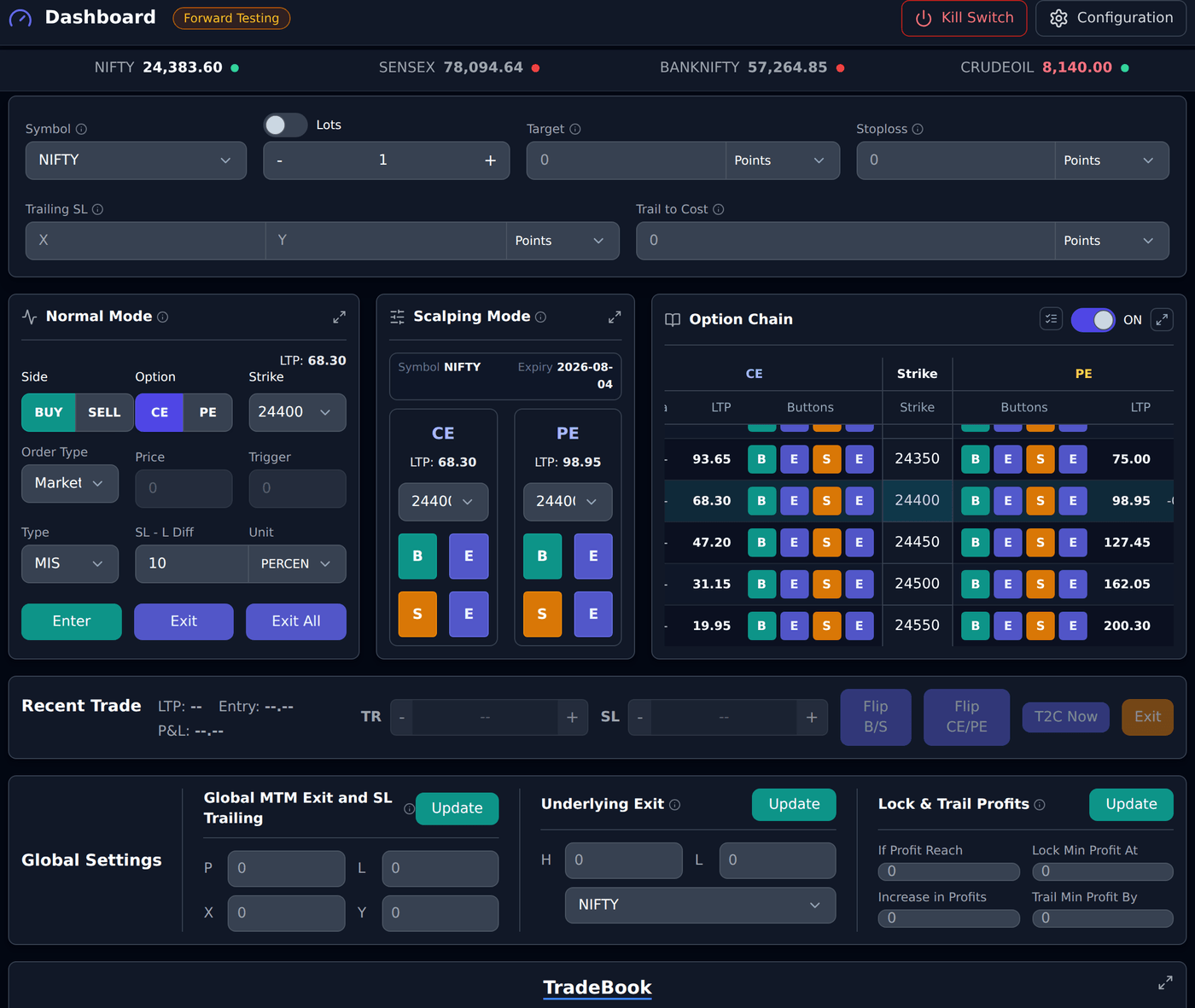
Underneath the speed sits a deep set of advanced controls made for option traders: a live option chain centred on ATM, per-trade stop loss, target, trailing stop and trail-to-cost, partial and half exits, flip actions, and MTM controls that watch the whole day rather than one position.
Which tool is this, and how is it different?
#Bluechip Algos has seven trading tools. Three place trades from a signal, three are for trading by hand, and one manages a stock portfolio. The quickest way to tell them apart is to ask what decides the entry.
- Trade Scalper (this one) — you decide, trade by trade. A discretionary tool for intraday traders and scalpers, with advanced controls built for option traders.
- Trade Disc — you decide, and then you adjust. A discretionary terminal for option traders who change a position after it is open — moving a leg to another strike, or changing its size, in one click.
- Trade Charts — you decide, on the chart. Options traded straight from the candles — entry, stop loss and target are lines you drag, with patterns and indicators drawn on the same chart.
- Trade Builder — indicators decide. RSI, moving averages, Supertrend, levels and candle patterns, worked out inside the platform on official candles. It analyses the index and places the order in options.
- Trade Bots — the clock decides. You give it times — enter at 09:20, exit at 15:10, on these weekdays. Straddles and strangles built around a schedule rather than an indicator.
- Trade Bridge — somebody else decides. Your signal comes from a third party such as TradingView. You configure what to trade here in Trade Apps, and the order is executed in your broker terminal.
- Equity Rebalancer — your stock list decides, on your schedule. You hold a fixed number of stocks in equal amounts and change the list every week or month. It works out what to sell and buy so every stock is even again, and buys shares for delivery rather than trading intraday.
Who this suits?
#It suits you if you watch the market yourself and want to act on what you see immediately, with proper risk controls attached to the trade rather than typed in afterwards.
It does not suit you if you want trades placed while you are away. Trade Scalper does nothing on its own — if you are not at the screen, nothing happens.
What you need before you start?
#The same essentials, plus one habit worth forming.
- An active subscription and a connected broker account.
- The right segment and underlying selected, so the option chain shows what you actually trade.
- A glance at Mode before every session. Forward Testing and Live Trading look the same on screen; only the mode says whether real money moves.
Nothing happens until you press it
#There is no rule engine here. No condition is evaluated, no candle is waited for. The only thing that places an order is you.
What the platform does is make that click safe: your stop loss, target and trailing settings are attached to the trade as it is placed, so a position is protected from the moment it exists rather than after you have found time to set it up.
What it cannot do?
#Stated plainly, so there are no surprises.
- It cannot trade while you are away — that is what the three automated tools are for.
- It cannot tell you what to trade. No tips, no signals, no view on the market.
- It cannot undo a placed order. Speed cuts both ways; check the side and quantity before clicking.